Oedipus
As a group of three, we will be performing a Greek theatre piece, Oedipus (the Oedipus and Tereisias extract.)
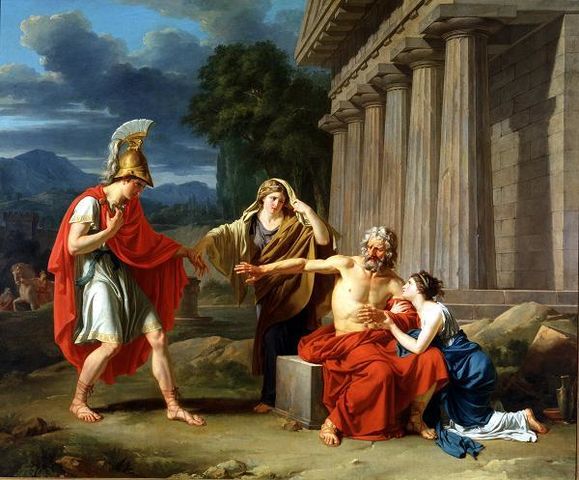
Each point, 1 - 6, is a way to improve our interpretation of our piece.
Each point, 1 - 6, is a way to improve our interpretation of our piece.

For example, researching the story behind my extract will allow to receive a better understanding of who my character is and how to portray them.

The story of Oedipus
"Oedipus was born to King Laius and Queen Jocasta. Laius wished to thwart the prophecy that said Oedipus would kill his father and marry his mother, so he sent a shepherd to leave Oedipus to die on a mountainside. However, the shepherd took pity on the baby and passed him to another shepherd who gave Oedipus to King Polybus and Queen Merope to raise as their own. This allowed Oedipus to live on and end up fulfilling the prophecy unknowingly."
I share the role of Tereisias, a blind man with the ability of seeing into the future. This means that as I speak to Oedipus in the extract, I could either play the role:
- Apprehensively and worriedly (because I know that Oedipus has already fulfilled the prophecy and I'm afraid to tell him.)
- Sarcastically and arrogantly (due to the irony of Oedipus searching for the murderer of Laios.)
- Disgustedly and ashamed like (because Oedipus has killed his father and mated with his mother.)

This shows how to make the piece seem realistic even though we are playing characters and not the actual people.
Having an objective and knowing the subtext allows me to know how to act and react to the dialogue because I know what impression I'm trying to give to the audience and I know what I'm trying to achieve.
We performed our pieces in class and received this general feed back:
- Keep the objective in mind
- Put emphasis on significant lines ("hideous intimacy" for example.)
- Think about the life of the character off the page, understand what kind of person they are and apply that to the performance
- Try to keep your own voices and styles when performing
- Don't look down, keep eye lines up (we think it's good to look down for dramatic effect during a theatrical moment but it's better to show your facial expressions.)
- Open up and be vulnerable in terms of body language and gesture (no keeping your hands behind your back etc.)
- Avoid performing the whole piece upstage (you're far away from the audience so it's harder for them to observe and hear.)
Feedback specifically for me:
- Project my voice more
- Look for moments for my partner and I to say lines together
Evaluation:
Watching the performance video back, I see that we didn't make very good use of the stage space, and had very little movement/gestures, moving forward this is something i will keep in mind for future performances. However, I delivered the lines well, emphasising certain words and staying in role.
Having an objective and knowing the subtext allows me to know how to act and react to the dialogue because I know what impression I'm trying to give to the audience and I know what I'm trying to achieve.
We performed our pieces in class and received this general feed back:
- Keep the objective in mind
- Put emphasis on significant lines ("hideous intimacy" for example.)
- Think about the life of the character off the page, understand what kind of person they are and apply that to the performance
- Try to keep your own voices and styles when performing
- Don't look down, keep eye lines up (we think it's good to look down for dramatic effect during a theatrical moment but it's better to show your facial expressions.)
- Open up and be vulnerable in terms of body language and gesture (no keeping your hands behind your back etc.)
- Avoid performing the whole piece upstage (you're far away from the audience so it's harder for them to observe and hear.)
Feedback specifically for me:
- Project my voice more
- Look for moments for my partner and I to say lines together
Evaluation:
Watching the performance video back, I see that we didn't make very good use of the stage space, and had very little movement/gestures, moving forward this is something i will keep in mind for future performances. However, I delivered the lines well, emphasising certain words and staying in role.


Comments
Post a Comment